In Romans 1, we see the human race operating outside God’s plan. It is not a pretty picture, though it is accurate (Galatians 5). Most people will agree with the picture that is presented and say, “I am glad I am not like that.”
The second chapter of Romans is written to those who may think the first chapter doesn’t apply to them. Such a person says, “I am upright and moral and really don’t need anything.” They identify with the viewpoint of “I’m ok. You’re ok.”
Romans 2 teaches us that not only those who are down and out need to experience faith in Jesus Christ, but also those who think their morality is enough and that they don’t need God’s grace. This revelation leaves us with a clear choice.
- Judging brings self-condemnation; God’s grace leads us to repentance (Romans 2:1-4)
- Judging condemns us
- The term means judging the actions of another with a view toward passing a sentence and enforcing it
- Jesus told us a story about a self-righteous person in Luke 18:11-14
- Repentance is an act of God’s grace
- We would all fall under condemnation but for God’s grace that leads us to repentance
- Who is better: the person who elevates himself or the one who humbles himself?
- Humble yourself under the mighty hand of God, that you may be exalted in due season
- Judging condemns us
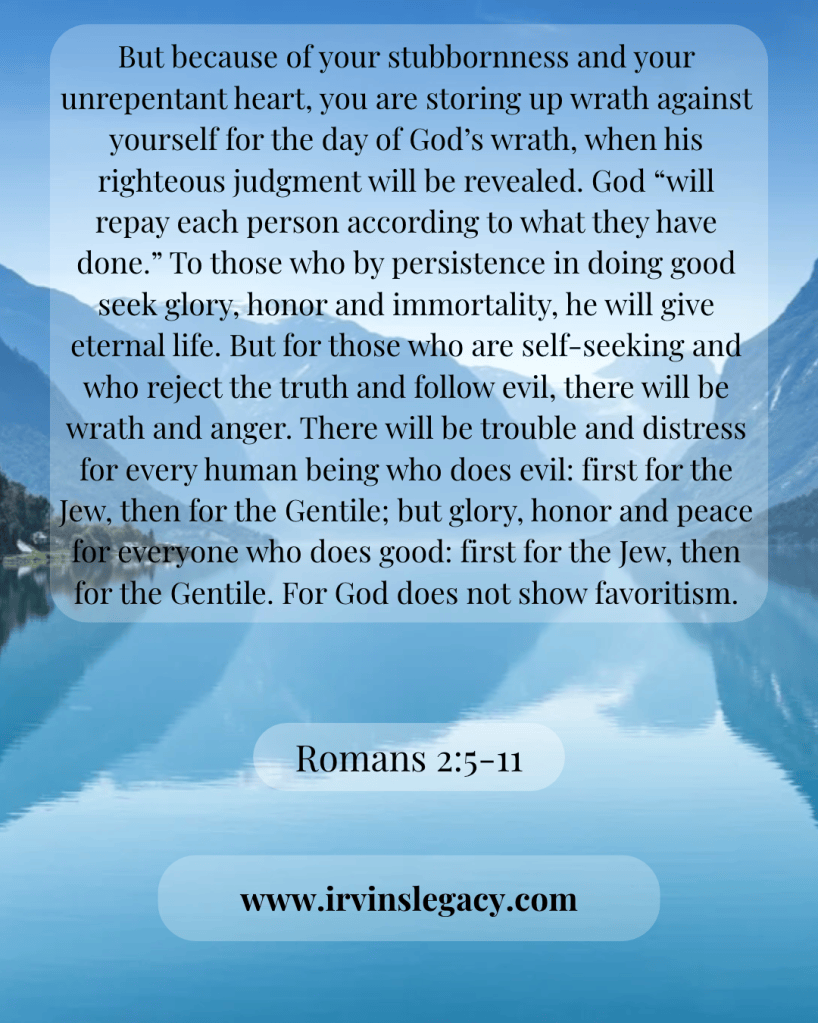
- Stubbornness and unrepentance condemn; obedience leads to life (Romans 2:5-8)
- A judging heart that does not forgive condemns
- Obedience to God produces life
- Quality now
- Quantity later
- Disobedience brings distress; uprightness produces peace (Romans 2:9-16)
- We can choose what we will experience
- Tribulation
- Peace
- We can choose what we will experience
What we experience depends on what we do with what we know. Having seen how God deals with us, and that every action and attitude has a corresponding result, each of us must examine ourselves before God and take steps that produce the positive results of repentance and obedience, so we can experience His blessing rather than His wrath.
Illustration: What we need, if we are to forgive freely, is a tolerance of others as generous as the tolerance we display toward our own errors. It is remarkable how understanding we can be with our own “flops” in interpersonal dealings-we didn’t intend the error, or it happened in a moment of stress, or we weren’t feeling right that day, or we’ll know better for next time. We tend to see ourselves not for what we are but for what we strive to be, whereas we see others for what they are. Jesus, in His encounters with people like the woman at the well or Peter, saw them for what they were trying to be. Excerpt from “The Art of Creative Forgiveness” by Alan Loy McGinnis, The Messenger, 2/5/1982